UC Berkeley Productivity Automation
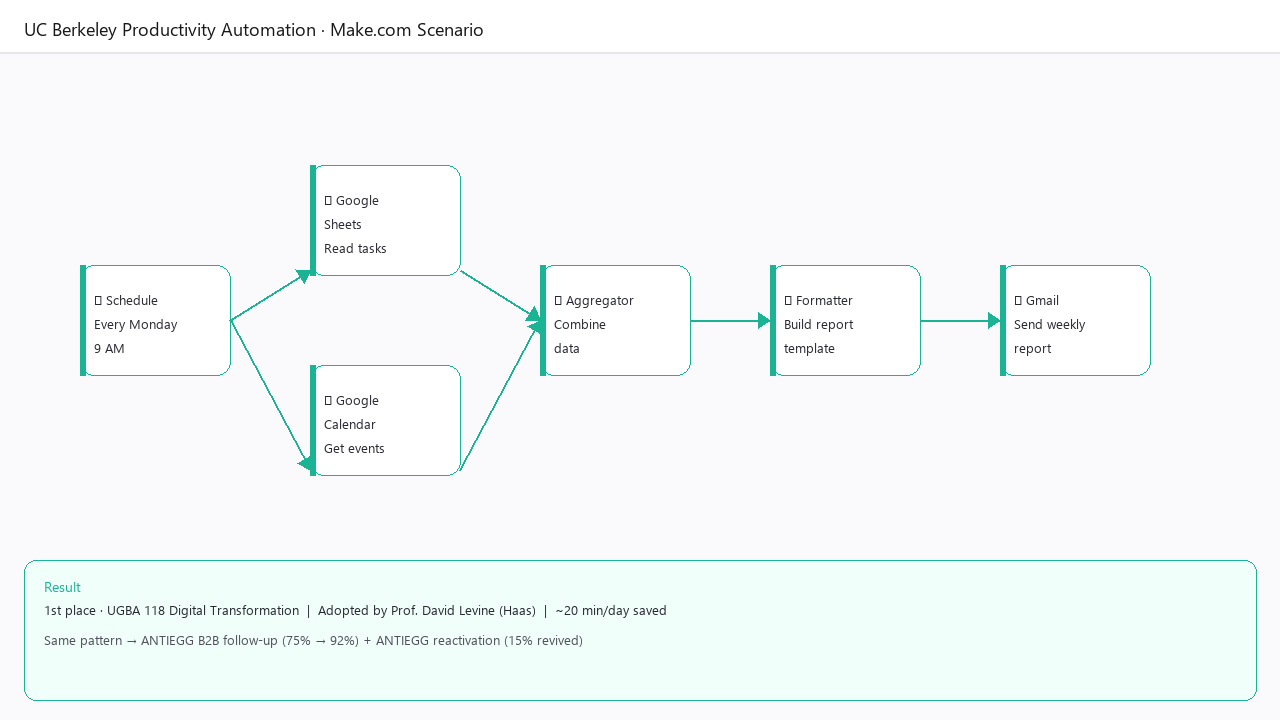
Make.com automation generating weekly productivity reports. • Won 1st place in UGBA 118 Digital Transformation course • Adopted by Haas dept. chair (Prof. David Levine) — saves ~20 min/day
Metrics
- Class demo result: 1st place
- Adopter: Haas faculty toolkit
- Time saved per day: ~20 min
- Reuse multiplier: 3 deployments
- ANTIEGG inbound conversion: 75% → 92%
- ANTIEGG dormant reactivation: 15%
Highlights
- Designed for hand-off, not for a demo grade
- Adopted by Haas faculty, not just demoed to them
- 1st place out of the cohort
- One pattern, three production deployments
- No-code by choice, not by limit
Story
Situation
At UC Berkeley Haas UGBA 118, the professor mentioned in class that even the dean was trying to improve his productivity through automation. I asked directly: can I build it for you? Most teams aimed to satisfy the assignment. I wanted a workflow that would still be running after the demo.
Task
Diagnose the real problem before building anything. Then deliver a working automation that lands in the professor's inbox every morning — zero manual steps, and maintainable by a non-engineer.
Action
Used 5 Whys to find the root cause: the surface problem was 'planning takes too long,' but the actual bottleneck was 'priority context is scattered across multiple tools.' Built a Make.com scenario that pulls from Outlook calendar and Excel task list, applies hardcoded scheduling rules collected in the interview (work priority weights, time-of-day principles), and delivers a ranked task list by email every morning at 7am. Chose Make.com deliberately — a non-engineer can open the scenario, read what each step does, and edit it without me.
Result
1st place at class demo. Adopted by Prof. David Levine (Haas faculty) — saving ~20 minutes per day. Honest note: the original target was 30 min/day. We hit 20 because task entry still happened in the original spreadsheet, creating a round-trip. If I rebuilt it today, I'd build a web admin that centralizes all data input — no more switching between tools. Same scenario design ported to ANTIEGG: inbound B2B conversion 75% → 92%, dormant reactivation 15%. One pattern, three live deployments.